PUBLICATIONS

本页汇集高分辨率增材制造、功能性无机材料、二氧化硅玻璃微结构及可重构微系统方向的代表性研究成果。

基于单一预陶瓷树脂的超强超韧微纳硅氧碳陶瓷三维打印

Gan Luo§, Yuan Tao§, Jincheng Ni, Modong Jiang, Feng Tang, Yanlei Hu, Dong Wu, Jiaru Chu, and Jiawen Li*

摘要

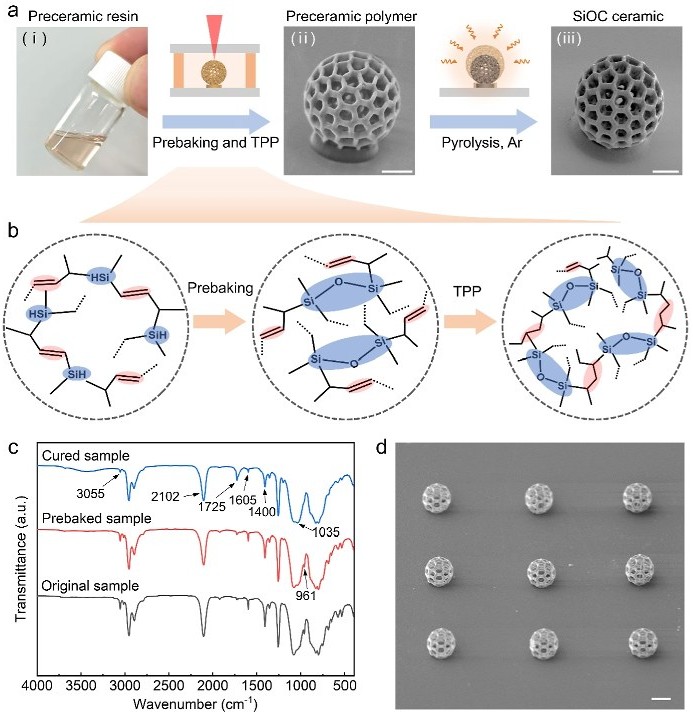
Polymer-derived ceramics (PDCs) are promising candidates for fabricating three-dimensional (3D) micro/nanodevices. However, their advancement has been constrained by a persistent challenge in that precursor simplicity, high-fidelity shaping of complex 3D architectures, and superior mechanical properties in the final ceramic are incompatible. To overcome this, an extremely simple photosensitive preceramic resin comprising only polycarbosilane and a photoinitiator is proposed to fabricate high-precision 3D PDC microstructures with intricate geometries and exceptional mechanical performance. A process involving prebaking and two-photon polymerization forms stable 3D preceramic polymer networks, which after pyrolysis yield defect-free amorphous SiOC ceramics exhibiting high shape fidelity and low linear shrinkage (28% at 1000 °C). The ceramics show temperature-dependent mechanical properties, with micropillar compressive strength reaching 6.41 GPa (1000 °C) and 7.55 GPa (1200 °C). Leveraging these properties, lightweight high-strength mechanical metamaterials with 20% relative density are fabricated, achieving a compressive strength of 0.54 GPa and a failure strain exceeding 10%. Functional microneedle arrays are also produced, highlighting their potential for biomedical applications. This work establishes a reliable and straightforward route from an extremely simple precursor to high-performance PDC micro/nano devices, showcasing promising prospects for applications in advanced microsystems and lightweight metamaterials.
ACS Nano, 2026, 20(27), 19299-19309

DOI: 10.1021/acsnano.6c02930

Figure 1 preview for the SiOC ceramics paper

基于毛细力辅助组装的二氧化硅玻璃微结构 4D 打印

Yuan Tao, Rui Li, Zhaoxin Lao, Yusheng Jin, Hao Wu, Zeheng Wu, Wei Zeng, Modong Jiang, Jincheng Ni, Yanlei Hu*, Dong Wu, Jiaru Chu, and Jiawen Li*

摘要

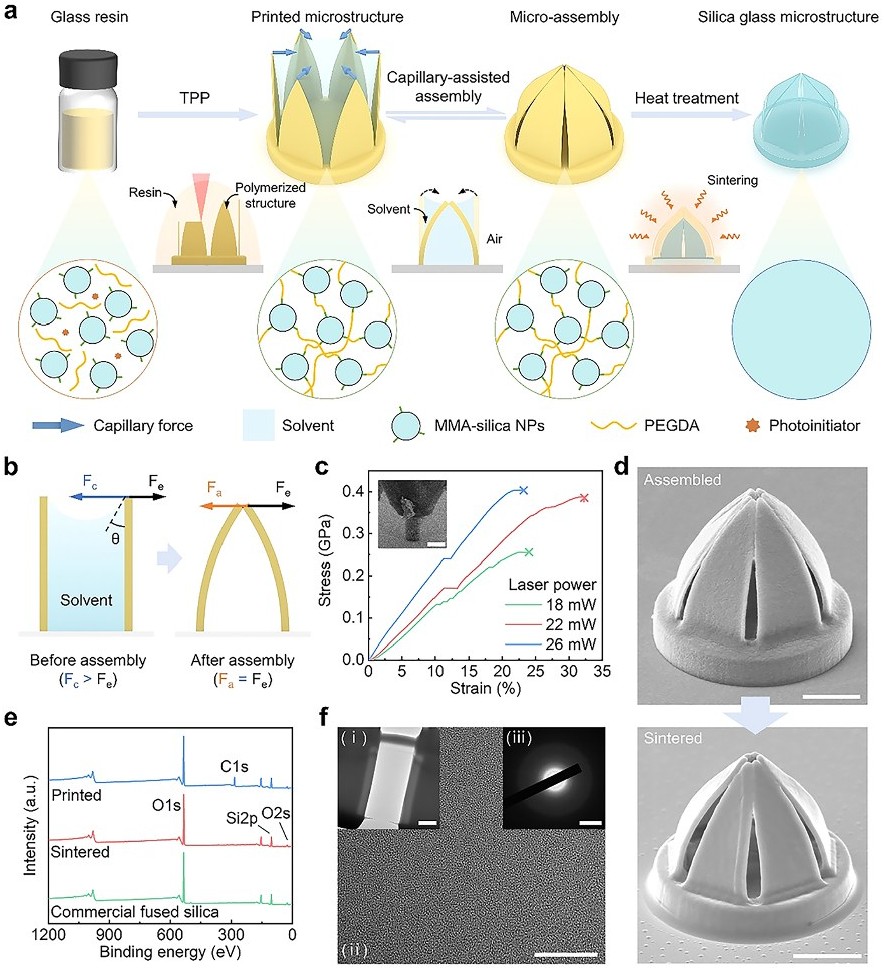
Four-dimensional (4D) printing enables simple structures to undergo programmed and controlled morphological reconfiguration for fabricating more complex three-dimensional (3D) architectures, which has recently garnered considerable research interest. However, 4D printing of glass, particularly for glass microstructures, faces fundamental challenges due to the limited deformability of glass and the lack of reliable deformation mechanisms. Here, a capillary-force-assisted assembly approach is presented to realize the 4D printing of glass microstructures with programmable morphing capabilities. The precursor microstructures fabricated by two-photon polymerization are reconfigured into complex 3D microassemblies under postprinting capillary force, ultimately yielding transparent glass microstructures upon thermal sintering. Compared with conventional 3D printing approaches, our 4D printing approach enables the fabrication of geometrically sophisticated glass microstructures, particularly development-resistant geometries such as hollow microarchitectures, which are previously unattainable through additive manufacturing techniques. Furthermore, the fabricated glass-based chiroptical metamaterials demonstrate giant chiroptical responses and enhanced environmental stability when compared to conventional polymeric counterparts. Fully enclosed hollow microarchitectures successfully encapsulate a diversity of inorganic particles. This work provides a scalable platform for advanced glass microfabrication and allows for the 4D printing of functional inorganic devices.

ACS Nano, 2025, 19(47), 40547-40560

DOI: 10.1021/acsnano.5c15343

Figure 1 preview for the 4D silica glass microstructures paper

面向微光学应用的低温烧结超低收缩三维透明纳米多孔玻璃打印

Yuan Tao, Xinyi Gu, Hao Wu, Jincheng Ni, Yanlei Hu, Dong Wu, Jiaru Chu, and Jiawen Li*

摘要

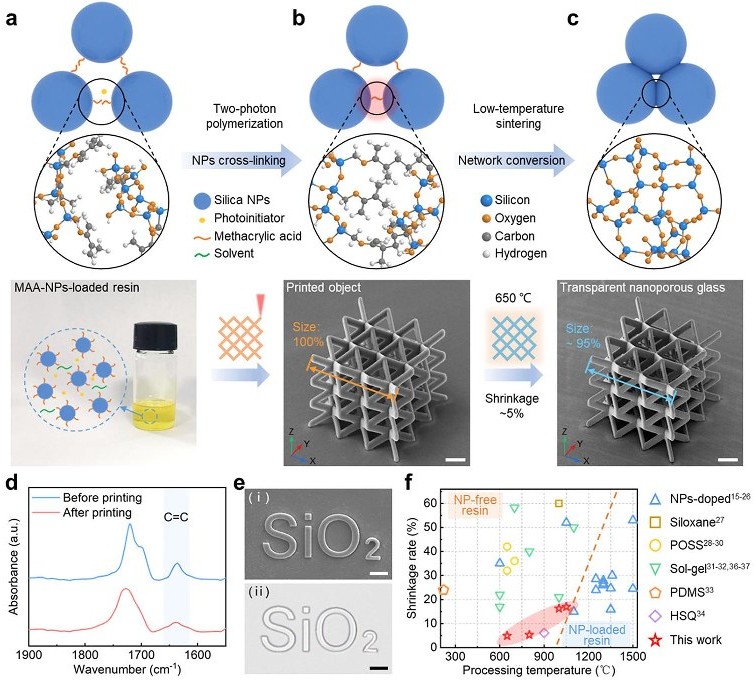
Current glass additive manufacturing relies on high-temperature processing to achieve optical transparency accompanied by significant structural shrinkage. These factors significantly restrict the micro-optical applications of three-dimensional (3D) glass microstructures in microsystems. Here, a low-temperature, low-shrinkage 3D printing strategy for transparent nanoporous glass microstructures is presented using a molecular cross-linker-free resin containing methacrylic acid-functionalized nanoparticles (MAA-NPs). The MAA-NPs serve dual roles as photopolymerizable units and silica precursors, enabling the creation of 3D microarchitectures with a 78 wt % solid loading through two-photon polymerization. In stark contrast to conventional particle-loaded composites, uniform nanoparticle dispersion eliminates wavelength-scale pores in the microstructure after sintering at 650 °C, achieving 97% visible-light transmittance. Most importantly, the combination of MAA cross-linking, which enables small interparticle spacing, and low-temperature sintering results in nanoporous glass 3D microarchitectures with low linear shrinkage (∼5%), thereby enabling high-fidelity fabrication of complex micro-optics. Crucially, our strategy enables direct in situ integration of glass microlenses on optical fibers at low temperatures, achieving high alignment precision without assembly steps. This strategy exhibits potential across multiple domains, including micro-optics, photonics, biomedical devices, and integrated optics.

ACS Nano, 2025, 19(35), 31643-31655

DOI: 10.1021/acsnano.5c09272

Figure 1 preview for the nanoporous glass printing paper

具有环境自适应运动能力的可重构螺旋微游动器快速制造

Rui Li§, Yuan Tao§, Jiawen Li*, Dongdong Jin, Chen Xin, Shengyun Ji, Chaowei Wang, Yachao Zhang, Yanlei Hu, Dong Wu, Li Zhang*, and Jiaru Chu

摘要

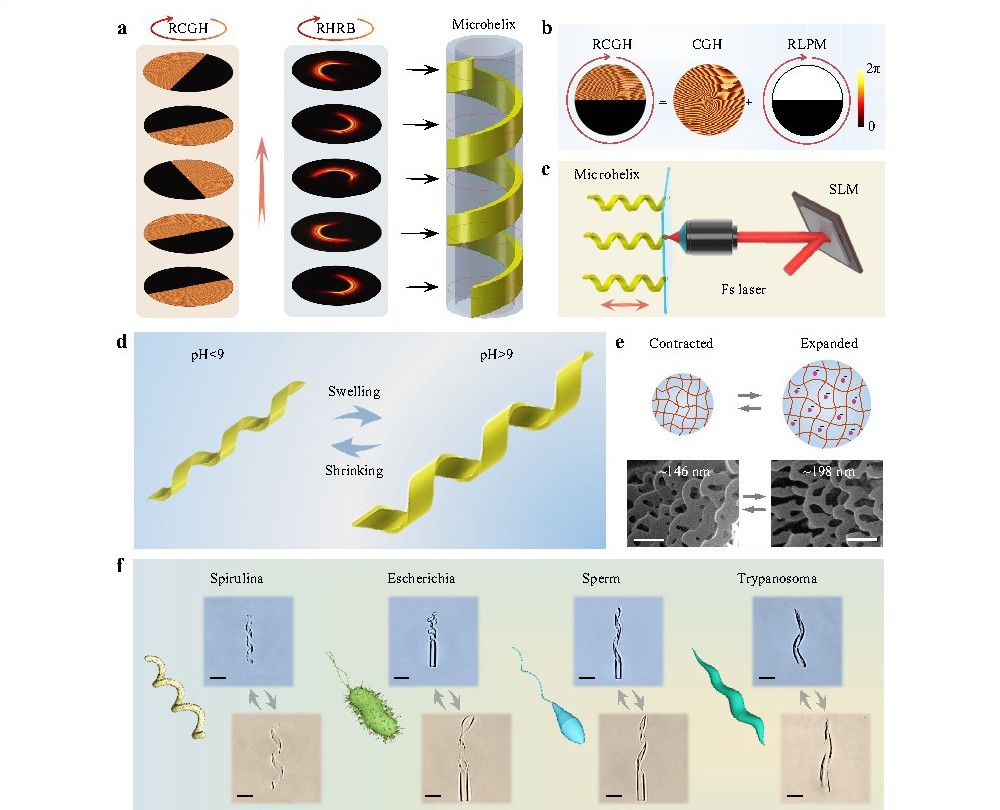
Artificial helical microswimmers with shape-morphing capacities and adaptive locomotion have great potential for precision medicine and noninvasive surgery. However, current reconfigurable helical microswimmers are hampered by their low-throughput fabrication and limited adaptive locomotion. Here, a rotary holographic processing strategy (a helical femtosecond laser beam) is proposed to produce stimuli-responsive helical microswimmers (<100 μm) rapidly (<1 s). This method allows for the easy one-step fabrication of various microswimmers with controllable sizes and diverse bioinspired morphologies, including spirulina-, Escherichia-, sperm-, and Trypanosoma-like shapes. Owing to their shape-morphing capability, the helical microswimmers undergo a dynamic transition between tumbling and corkscrewing motions under a constant rotating magnetic field. By exploiting adaptive locomotion, helical microswimmers can navigate complex terrain and achieve targeted drug delivery. Hence, these microswimmers hold considerable promise for diverse precision treatments and biomedical applications.

Light: Adv. Manuf., 2023, 4(4), 380-392

DOI: 10.37188/lam.2023.029

Figure 1 preview for the helical microswimmers paper